


World Of Toys
Publisher: Lambarde Press
Format: Hardback
ISBN: none
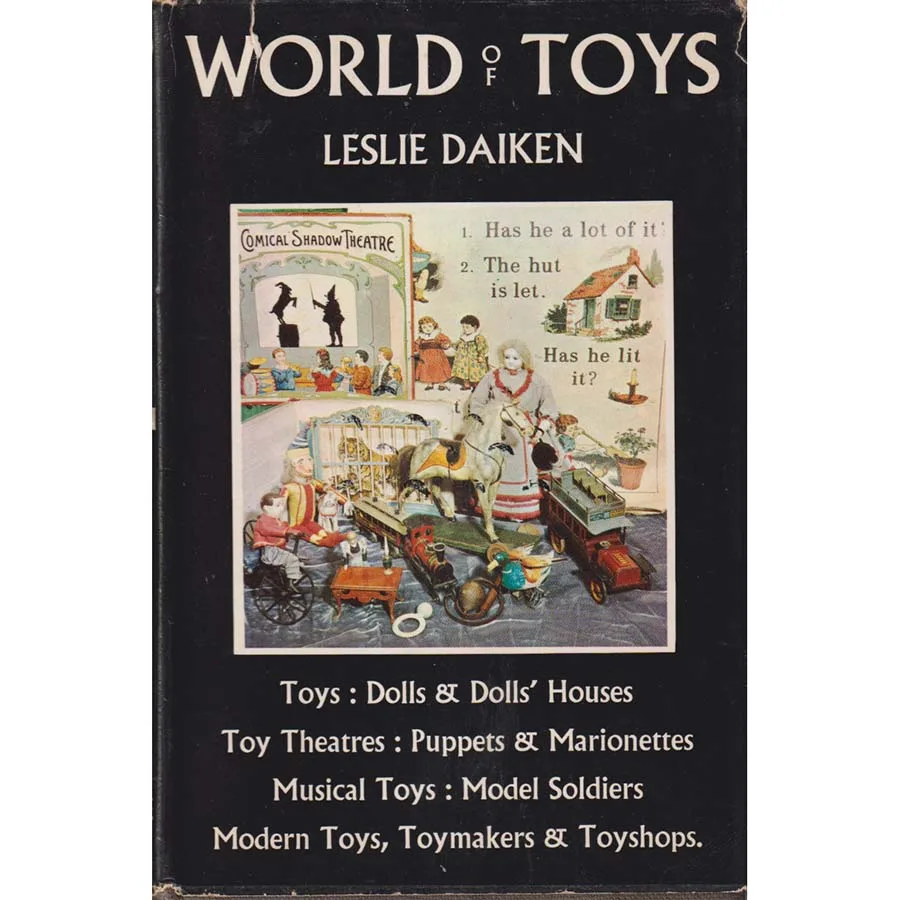
World of Toys (1963) by Leslie Daiken – Lambarde Press
Before toys required batteries, firmware updates, parental controls and an accompanying app that somehow needs your email address, they were generally expected to do something radical.
They relied on imagination.
Leslie Daiken’s World of Toys, published by Lambarde Press in 1963, is a charming exploration of the extraordinary variety of toys created for children across different places, periods and traditions.
And toys, it turns out, are much more revealing than they first appear.
A doll is never just a doll.
A wooden horse is not merely a wooden horse.
A tin train, puppet, spinning top or miniature cart can tell you something about the people who made it, the materials they had available, the lives children saw around them and the kind of world adults imagined children ought to rehearse for.
Which makes the history of toys slightly more serious than a nursery floor would suggest.
Daiken looks at toys not merely as playthings but as objects of craft, culture and social history.
Some are simple.
Some are ingenious.
Some are beautifully made.
Some look as though they were designed by a particularly determined uncle in a shed.
And some have survived long enough to become collectors’ items despite originally being intended for someone to drag behind them on a piece of string.
Published in 1963, the book comes from a fascinating moment in toy history.
Traditional wooden and handmade toys still had a strong presence, but plastics, mass production and modern manufacturing were transforming what children played with and how toys were made.
The old world and the new were overlapping.
A child might have a wooden fort, a tinplate car and something brightly coloured and moulded in plastic all in the same room.
Nobody yet knew that, within a few decades, many toys would begin speaking without being asked.
There is something particularly appealing about older books on toys because they treat play as something worth documenting.
Children’s objects are often dismissed as temporary things, used hard, broken, repaired, handed down and eventually thrown away.
Yet they preserve enormous amounts of social history.
What did adults think boys should play with?
What did they give girls?
Which toys represented work, war, transport, domestic life or fantasy?
What was considered educational?
And how many generations of adults sincerely believed that a child receiving a carefully made wooden toy would appreciate it more than the cardboard box?
The answer to the last question remains disappointing.
World of Toys is also likely to appeal to anyone interested in folk art and craftsmanship.
Toys are often miniature exercises in design and engineering.
Wheels must turn.
Figures must balance.
Joints must move.
Things must survive being dropped.
Usually repeatedly.
Often from stairs.
A toy that survives long enough to become antique has therefore passed one of the harshest durability tests known to manufacturing: ownership by a child.
There is also the unavoidable nostalgia factor.
Old toys have a peculiar ability to transport people instantly back to childhood.
One glimpse of a familiar train, doll or mechanical toy and an otherwise sensible adult may suddenly begin explaining in exhaustive detail that theirs was exactly like that except theirs was blue and had one wheel missing.
This book captures that world before nostalgia had fully taken over.
In 1963 many of the toys shown would still have been familiar objects rather than vintage treasures.
That makes the book itself part of the history it describes.
This copy is in Good condition, which is especially pleasing for a book about objects that generally received considerably rougher treatment than books ever did.
Ideal for collectors of vintage toys, social historians, designers, nostalgia enthusiasts, doll and model collectors, or anyone fascinated by the ingenious things humans have invented to stop children saying, “I’m bored.”
Also suitable for anyone who remembers when a toy could provide several years of entertainment without once displaying the message LOW BATTERY.
Sold by Crappy Old Books, where vintage toys are admired from a safe distance because the shelves are already full enough without somebody starting a collection of clockwork bears.
ISBN: None
Condition: Good
Keep browsing: See more Antiques books Other books by Leslie Daiken
